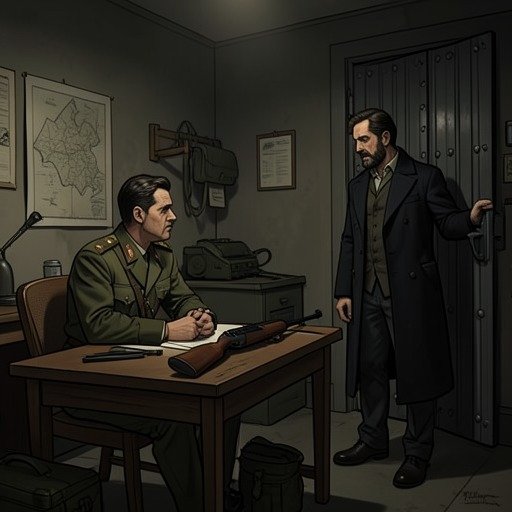
Vytautas Carr’s command and working relationship with Ratoff
Operation NapoleonVytautas Carr’s command and working relationship with Ratoff is defined by a sharp imbalance: Carr needs an effective, discreet operative on the glacier, but refuses to tell him what the operation is really seeking. Ratoff, in turn, follows orders while probing the gaps in Carr’s account, making their chain of command a contest over how much the subordinate is permitted to know.
Command Under Secrecy
Carr speaks with Ratoff by telephone while crawling out of the aircraft. When Ratoff challenges the use of expensive equipment, Carr answers that it is pointless to spend billions on it if it is not used, then demands to know what Ratoff has found. Ratoff dismisses the communications officer and waits until the tent is private before reporting that he has found only two crates of gold, despite having been told the plane was full of it. Carr suggests that more may be buried in the ice, but Ratoff doubts that gold explains the mission.
The Briefcase and the Limits of Disclosure
Ratoff’s questions turn the discrepancy in the cargo into a challenge to the mission itself. He points out that the aircraft is too small to have carried a heavy load and that its occupants had inadequate clothing and no provisions. From the numbers Carr has given him, Ratoff reasons that an American pilot and two Germans may have survived the landing, while a seventh man remains unaccounted for. Carr offers possibilities rather than answers: the missing man may have been buried farther away or may have tried to reach civilization. The possibilities leave the essential uncertainty intact, and Ratoff remains unconvinced that gold is the real objective.
Ratoff then asks whether Carr is searching for the general’s briefcase. Carr’s warning is blunt: Ratoff was selected to lead the operation for a reason, and his role is to carry out instructions, not to question the purpose. Ratoff lets the matter drop, but reports that he has found The American General's Aluminum Briefcase, the pilot’s logbook, and another book. He says he has not opened or examined any of them, preserving the distinction between finding the documents and knowing what they contain.
Carr responds by making the chain of custody explicit. Ratoff must secure every written item from the aircraft—including documents, briefcases, books, and passports—and deliver the entire collection to Carr alone, without allowing anyone else access. Carr calls this procedure part of the plan and advises Ratoff that remaining ignorant of the contents would be to his advantage. The order both confirms the papers’ importance and reinforces the relationship’s defining boundary: Carr entrusts Ratoff with the physical evidence while withholding the knowledge that would explain it.
A Calculated Choice
Carr’s authority over Ratoff rests on a choice he made decades before the glacier operation. In the early seventies, Carr personally recruited him as a military intelligence agent. Ratoff proved capable, but his effectiveness came at a human cost: Carr knew that he could be trusted to get things done, while people who worked with him felt no warmth toward him. Within the service, he became an almost invisible operative, surrounded by rumors that colleagues preferred not to investigate. Carr’s later doubt about having placed his faith in him does not erase the calculation behind the appointment: Ratoff’s capacity for violence was both a danger and a reason he was useful.
Carr knew more about Ratoff’s earlier life than most, though his knowledge remained incomplete. Ratoff had enlisted in the marines in 1968 and served two consecutive tours in the Vietnam War. He explained the facial scar he already bore when he met Carr as the result of an accidental rifle discharge in his barracks. Carr did not simply accept that account: he sent someone to question men from Ratoff’s platoon, who gave differing versions of his conduct and of how he had been wounded. Their stories described a soldier who went further than others in trying to extract information, sometimes when there was none to obtain; the common account of the injury was that a young Vietnamese woman seized his gun, shot him in the face, and then killed herself. The episode leaves Carr’s knowledge substantial but unsettled: he investigates Ratoff, yet cannot reduce the man’s past to a verified record.
Ratoff’s subsequent assignments widened the gulf between his official status and his practical value. He served in South America, including El Salvador, Nicaragua, Chile, and Guatemala, working alongside forces sent to support dictators; after the United States cut back that support amid protests at home, he was moved to the Middle East. In Lebanon he served for a time with Mossad. By then he officially did not exist: his intelligence records had been removed from ordinary circulation, and Carr was among only a handful of senior officials who knew he was there. That concealed status made Ratoff suitable to lead the glacier operation, where secrecy mattered as much as obedience. Carr entrusted him with the wreck and its documents, but not with the reason they mattered; the relationship joined professional reliance to deliberate exclusion.
Reliance and the Cost of Control
Carr’s confidence in the operation depended on keeping its consequences manageable in public, not on winning anyone’s trust. The wreckage and its contents came first; once secured, the soldiers could return to base while the admiral supplied a plausible explanation for their presence. Carr expected misinformation to make reports about the army suspect and assumed that public anger over the incursion would soon fade beneath economic considerations. His confidence extended to the cover story, but not to Ratoff’s judgment: he privately wondered whether choosing him had been a mistake, because Ratoff accomplished what was asked at a steep cost in human lives.
That doubt sharpens the contradiction at the heart of Carr’s reliance on him. Ratoff was useful precisely because he operated beyond ordinary scrutiny, and his disappearance from official records made him easy to deploy and, in Carr’s calculation, easy to lose. Yet Carr’s control had limits. He could order Ratoff to secure every paper and keep him ignorant of its meaning, but he could not make the subordinate stop recognizing that the stated search for gold failed to explain the mission. Carr’s command therefore rests on enforced procedure rather than shared purpose: Ratoff is trusted with the objects, denied their significance, and expected to accept the danger without being told what it serves.